If you've spent any time researching how to scale an online store in 2026, you've probably run into the term "headless commerce" — usually surrounded by jargon like MACH(Microservices, API-first, Cloud-native, Headless) architecture, composable commerce, and API-first design. Strip away the buzzwords, and it's actually a simple idea that solves a very real problem: your storefront and your backend shouldn't be stuck together.
Here's what that means, why it matters for a growing business, and how to know if it's the right move for you.
What Headless Commerce Actually Means
In a traditional e-commerce setup — think a standard Shopify or WooCommerce store — the "front end" (what customers see: product pages, cart, checkout) and the "back end" (inventory, orders, payments, pricing logic) are bundled together as one system. Change how a product page looks, and you're often limited to what the platform's templates allow. Want a custom checkout flow, a native mobile app, or a totally unique homepage design? You're fighting the platform, not building with it.
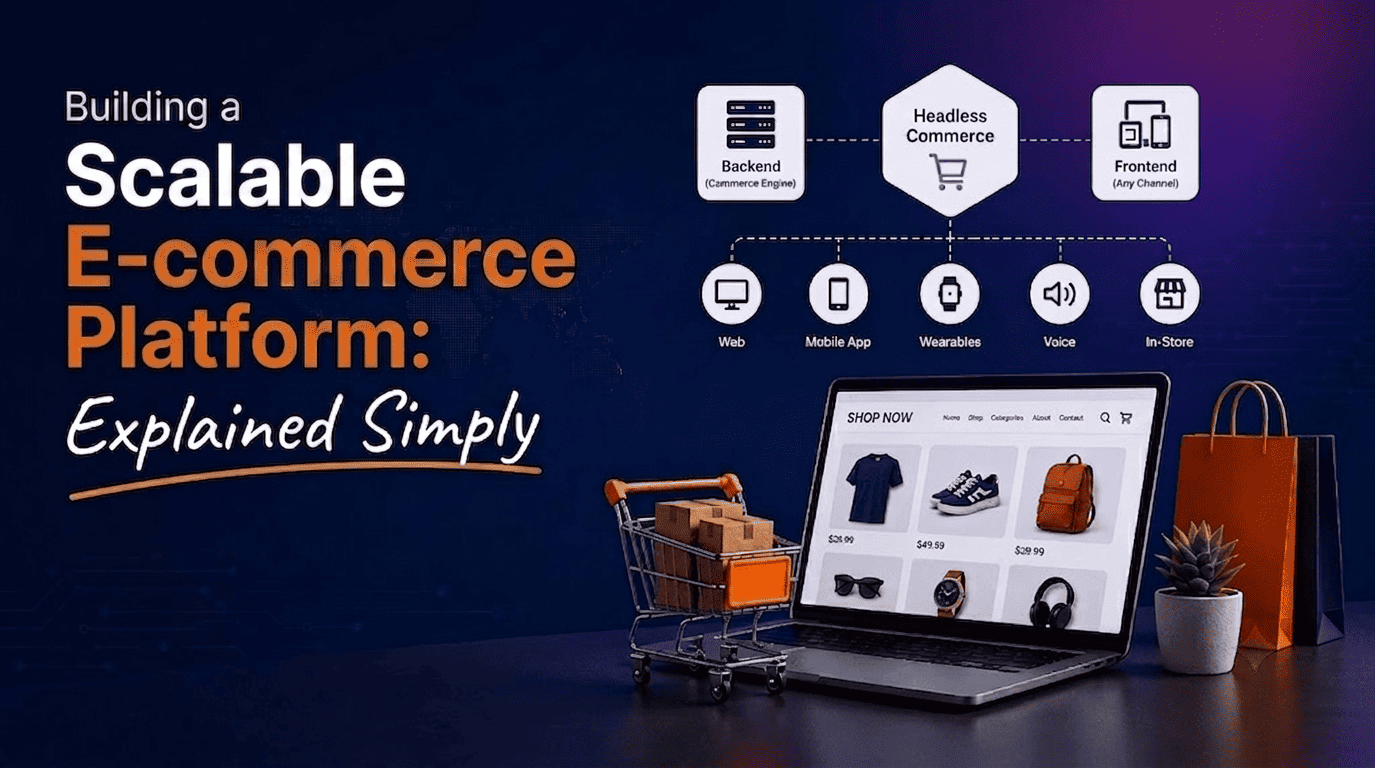
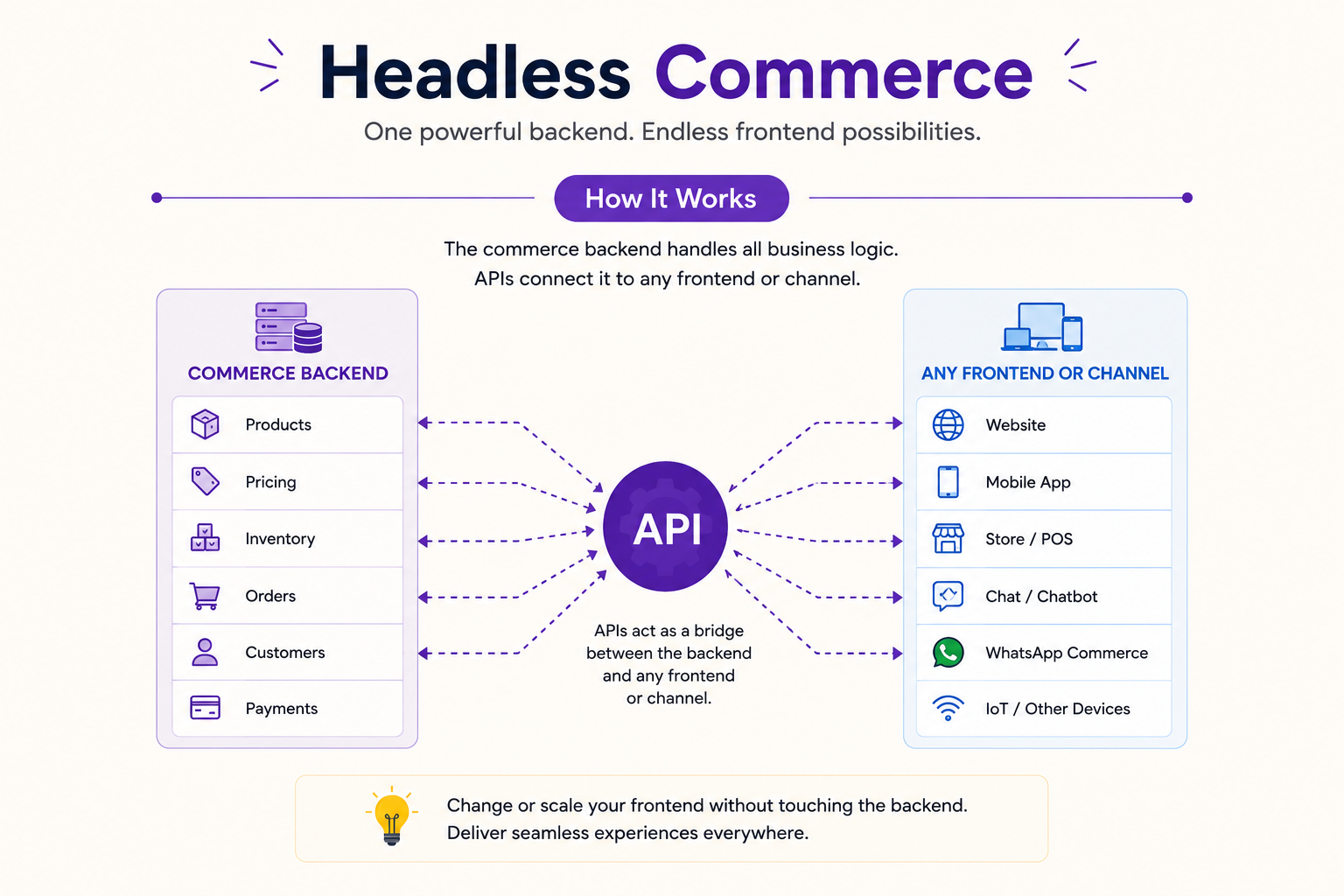
Headless commerce splits these two apart. The backend keeps handling products, inventory, orders, and payments — think of it as the kitchen. The frontend — what the customer actually sees and interacts with — is built independently, connected to the backend only through APIs. That's the "head" being removed and replaced with whatever interface you want: a website, a mobile app, a smart TV app, even a voice assistant.
Because the two sides only talk to each other through APIs, your development team can rebuild the entire customer-facing experience without touching order processing or inventory logic — and vice versa.
Why This Matters More in 2026 Than It Used To
A few years ago, headless commerce was mostly an enterprise conversation — something only large retailers with big engineering teams considered. That's changed. As shopping has spread across websites, apps, marketplaces, and social commerce, businesses of every size are running into the same wall: their platform can't keep up with how many places customers now expect to buy from.
A few shifts are driving this:
- Speed is now a revenue metric, not just a UX detail. Since the storefront runs independently from the backend, teams have far more control over page load speed, caching, and content delivery — and even small delays in load time measurably hurt conversion rates. In a market where customers abandon a slow cart in seconds, that control isn't optional anymore.
- Omnichannel is the default, not the exception. Customers now move between your website, your app, Instagram shopping, and marketplaces like Amazon within the same buying journey. A headless setup lets one backend power all of those "heads" consistently, instead of managing separate, disconnected systems for each channel.
- Personalization requires flexibility templates don't offer. Whether it's AI-driven product recommendations, dynamic pricing, or region-specific catalogues, these features usually need custom logic that a rigid, all-in-one platform simply wasn't built to support.
- Composable commerce is the natural next step. Rather than one monolithic platform doing everything adequately, businesses are now assembling best-in-class tools — a separate search provider, a separate payments processor, a separate CMS — and wiring them together through APIs. Headless architecture is what makes that modular approach possible in the first place.
The Real Trade-Offs (Because It's Not Free)
No serious blog post should pretend headless commerce is the answer for everyone — because it isn't.
- It requires real development resources. Unlike a drag-and-drop store builder, a headless setup needs developers to build and maintain the frontend, connect the APIs, and keep both sides in sync. This isn't a weekend project.
- It costs more upfront. You're essentially building custom software instead of configuring an out-of-the-box platform. That's a bigger initial investment, even if it pays off in flexibility and speed later.
- It's overkill for very simple stores. If you're running a small catalog with straightforward needs and no plans for rapid growth, a traditional platform will get you to market faster and cheaper. Headless commerce earns its cost when complexity — catalog size, integrations, multiple channels — starts to outpace what a template-based platform can handle.
The businesses that benefit most are the ones already feeling the limits of their current platform: slow page speeds hurting conversions, developers fighting the CMS to make basic changes, or a growing need to sell across multiple channels from one consistent backend.
How to Know If You're Ready
A simple gut check: if your team spends more time working *around* your e-commerce platform than *with* it — waiting on plugin updates, unable to customize checkout, struggling to launch on a new channel — that's usually the signal that a headless, composable architecture is worth the investment. If your store is still growing into its first few thousand orders a month and your current platform handles that fine, there's no rush to rebuild something that isn't broken yet.
How VolanSoft Helps Businesses Build and Scale E-commerce Platforms
This is exactly the kind of work we do. At VolanSoft, we help growing businesses move past the limitations of template-based stores by building custom, API-first e-commerce platforms — architected the headless way from day one, or migrated over time as the business outgrows its current setup.
That means we handle the full picture: a fast, modern storefront built with frameworks like React or Next.js, a backend that manages your inventory, orders, and payments cleanly, and the API integrations that connect your store to the payment gateways, CRMs, shipping providers, and marketplaces your business actually runs on. Whether you're an early-stage brand building your first serious storefront or an established retailer whose current platform can't keep up with your growth, we design the architecture around where your business is headed — not just where it is today.
If your store is starting to feel like it's holding your business back instead of helping it grow, that's a conversation worth having before your next big sales season, not during it.
Talk to VolanSoft about your e-commerce platform.